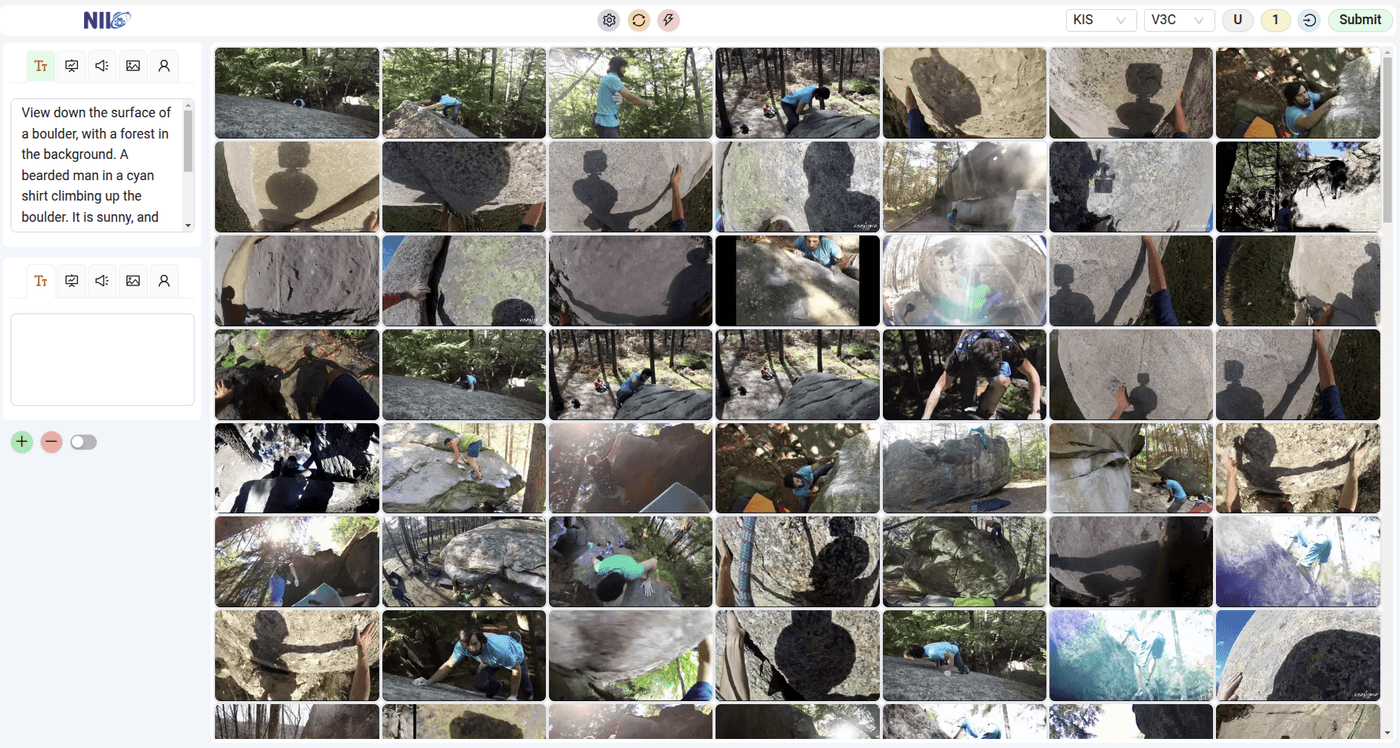
Interactive video retrieval (IVR) is challenging due to its multimodal nature, ambiguous user intent and strict real-time constraints. We introduce a unified, multimodal, context-aware framework for large-scale IVR. A fast, scalable design leverages GPU-accelerated indexing, parallel inference and lightweight fusion for sub-second responsiveness at million-scale; a multimodal architecture integrates vision-language embeddings, scene text, speech transcripts and object-level cues through adaptive score fusion to mitigate modality bias; and a multi-stage sequential retrieval paradigm handles ambiguous or partially ordered queries via coarse-to-fine expansion and context-aware alignment.
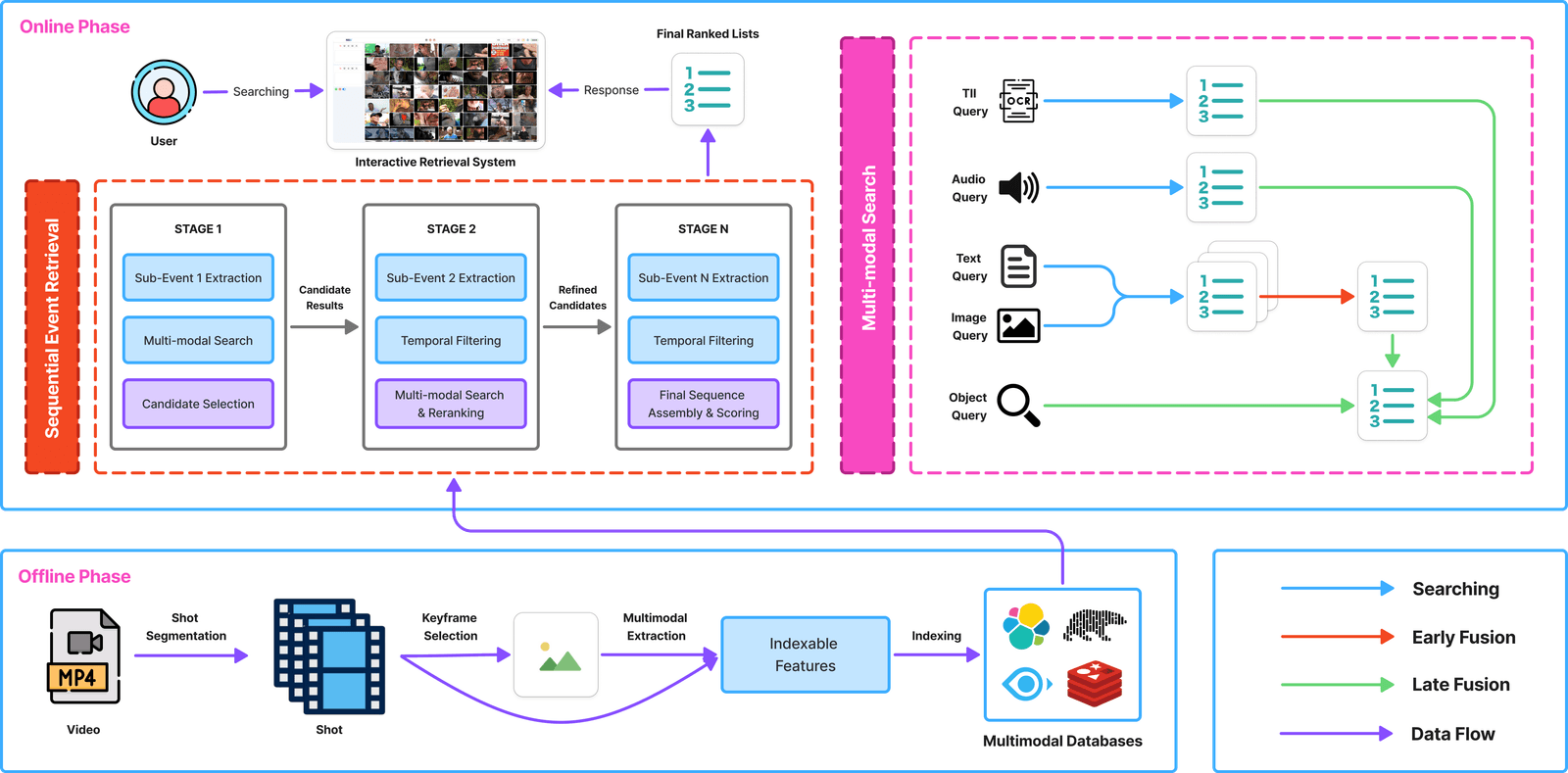
The framework follows a unified two-phase architecture. Offline, videos are segmented into shots; keyframes are extracted and indexed with multimodal representations — semantic embeddings, scene text, speech transcripts and object detections — using Milvus for vector search and Elasticsearch for text. Online, user queries are encoded with the same models, candidates are retrieved via hybrid multimodal search, then refined through reliability-weighted score fusion, optional object/audio alignment and sequential event retrieval.
Three contributions: (1) a GPU-accelerated, scalable backend that sustains real-time interaction at million-scale; (2) reliability-weighted multimodal fusion across an ensemble of vision-language models (CLIP, BEiT-3, InternVL-G) plus text-in-image and spoken-content retrieval, mitigating modality bias under noisy evidence; (3) a two-stage context-aware sequential event retrieval that expands candidates within a temporal neighborhood for robust reasoning over loosely ordered events.
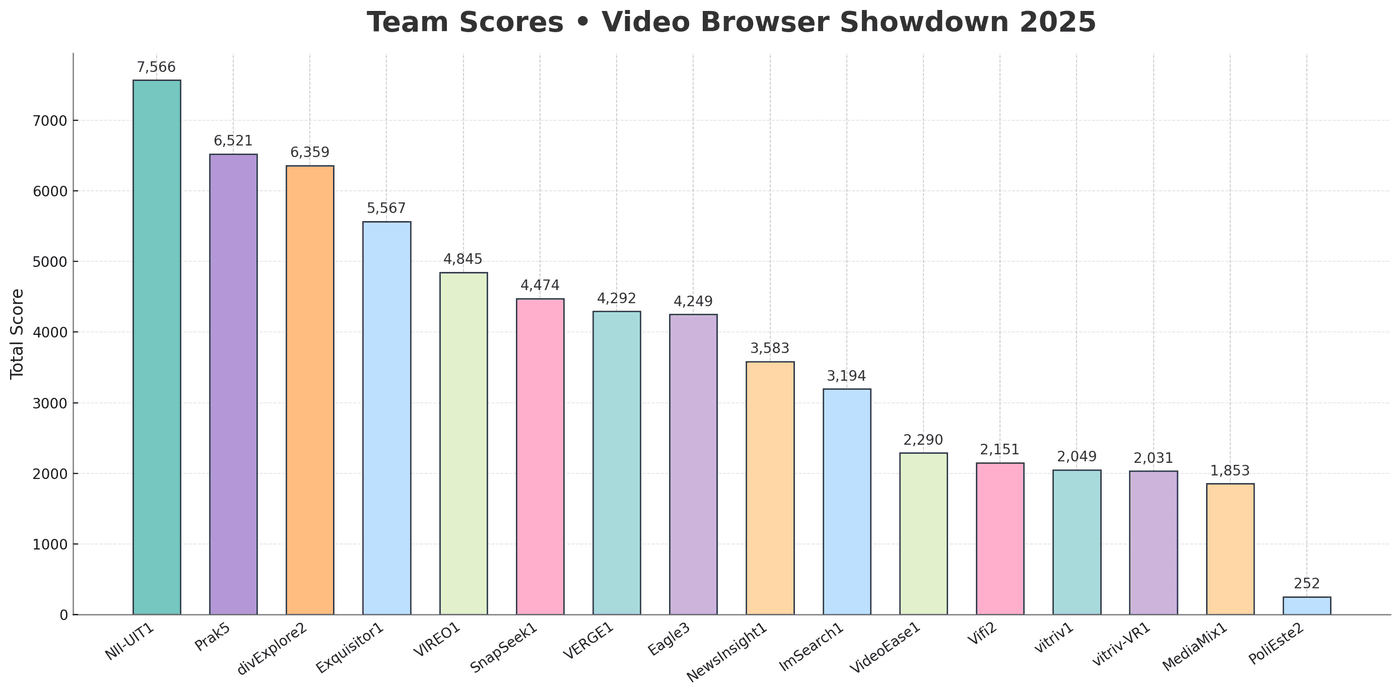
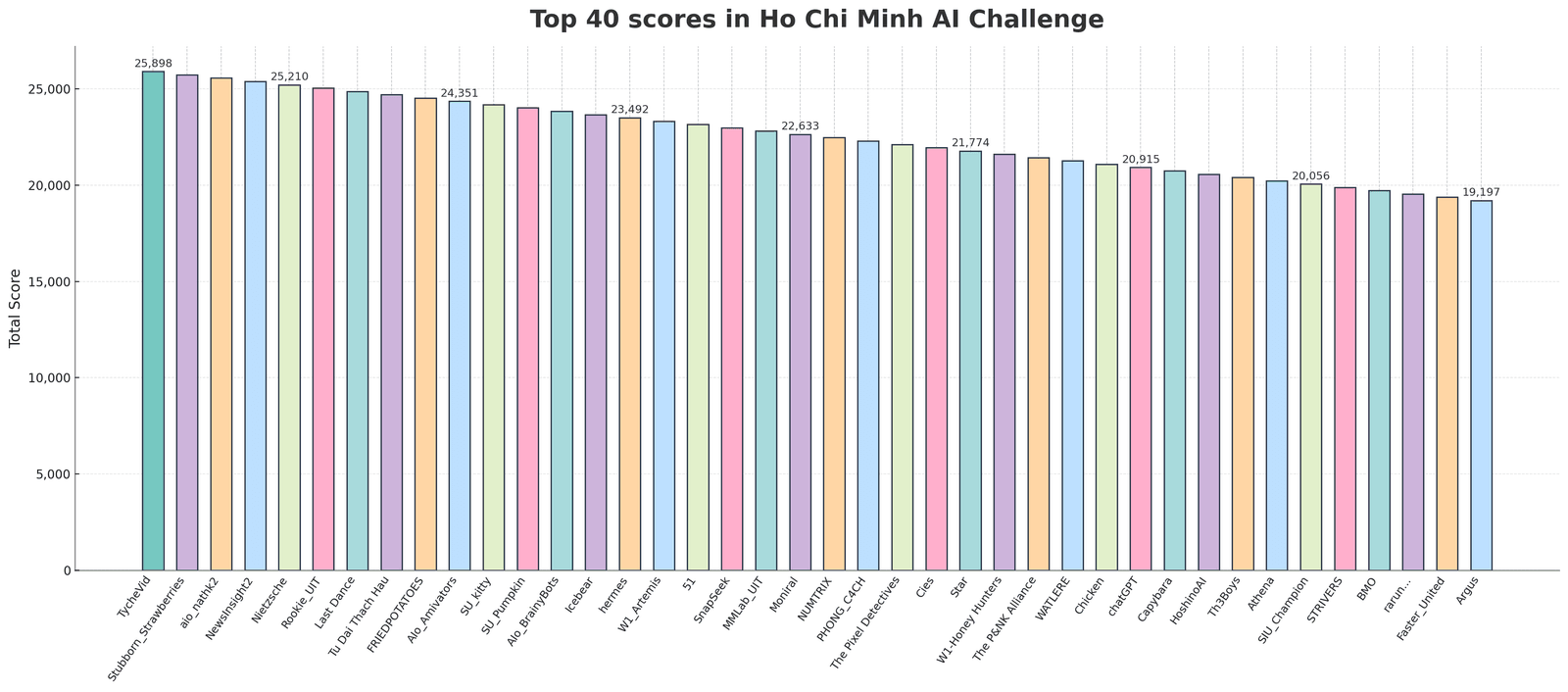
First place at the Video Browser Showdown (VBS) 2025, surpassing established state-of-the-art interactive systems under heterogeneous, time-critical conditions. Three consecutive first-place finishes at the Ho Chi Minh AI Challenge (AIC) 2022–2024 on multilingual broadcast media. The framework was further validated on four datasets spanning open-domain web video (V3C, ~28,450 videos / 3,800 hours), underwater footage (MVK), laparoscopic surgical recordings (LapGynLHE) and Vietnamese news (AIC, 1,471 videos / 328 hours), using a benchmark of 72 VBS and 50 AVS queries — confirming scalability, robustness and cross-domain generalization.