The rapid expansion of video data across various domains has heightened the demand for efficient retrieval and question-answering systems, particularly for long-form videos. Existing Video Question Answering (VQA) approaches struggle with extended video sequences due to high computational costs, loss of contextual coherence, and challenges in retrieving relevant information. We introduce VRAG: Retrieval-Augmented Video Question Answering for Long-Form Videos, a framework that brings a retrieval-augmented generation (RAG) architecture to the video domain. VRAG first retrieves the most relevant video segments, then applies chunking and refinement to identify key sub-segments, enabling precise and focused answer generation. This maximizes the effectiveness of the Multimodal Large Language Model (MLLM) by ensuring only the most relevant content is processed.
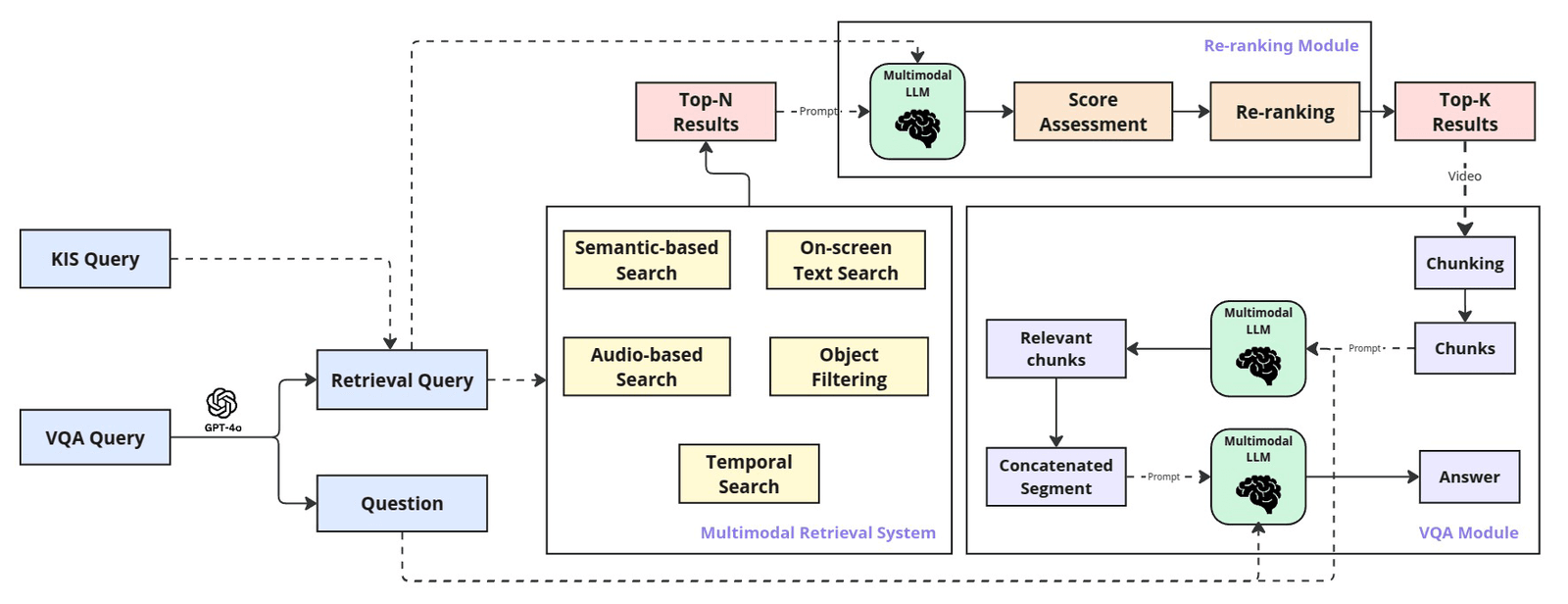
VRAG brings retrieval-augmented generation (RAG) to long-form video question answering. A query — Known-Item Search or VQA — is encoded and run through a multimodal retrieval system that combines semantic-embedding search, on-screen text search, audio-based search, object filtering and temporal search. The top candidates are then re-scored by an MLLM-based re-ranking module before a dedicated VQA module produces the final answer.
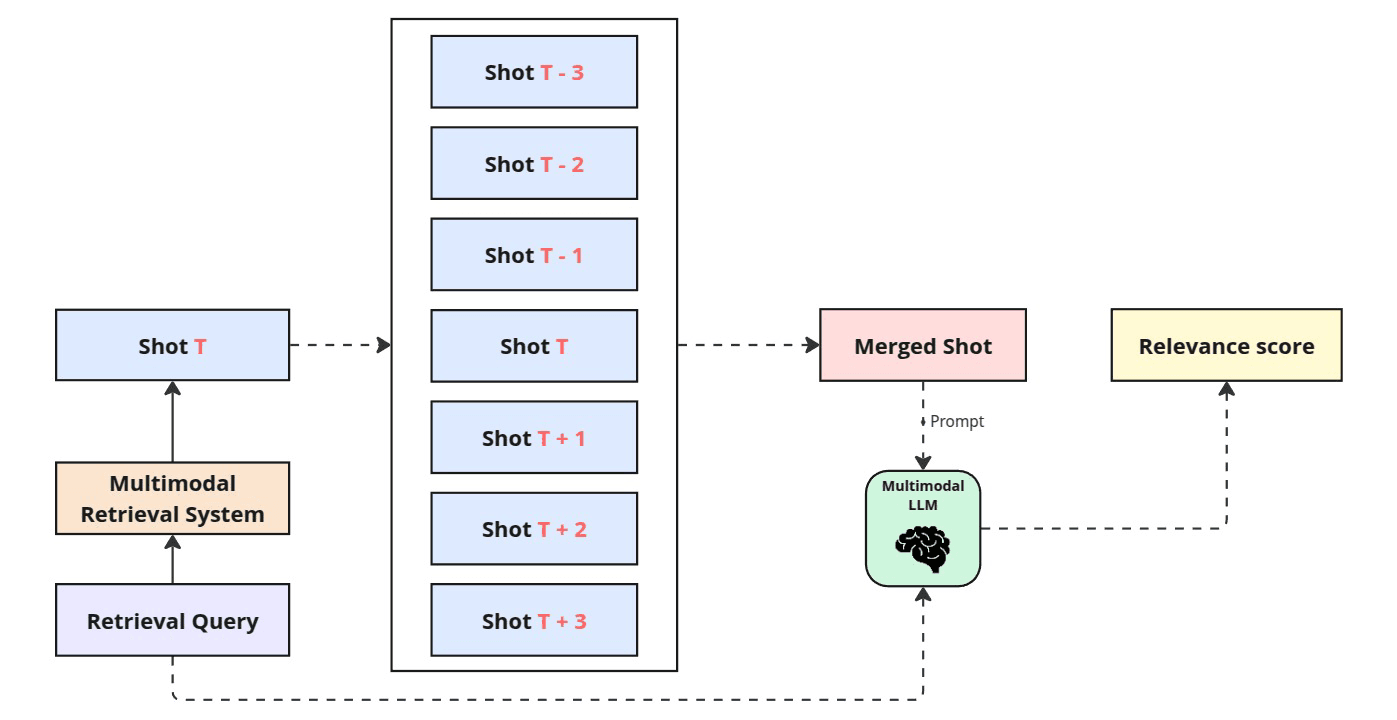
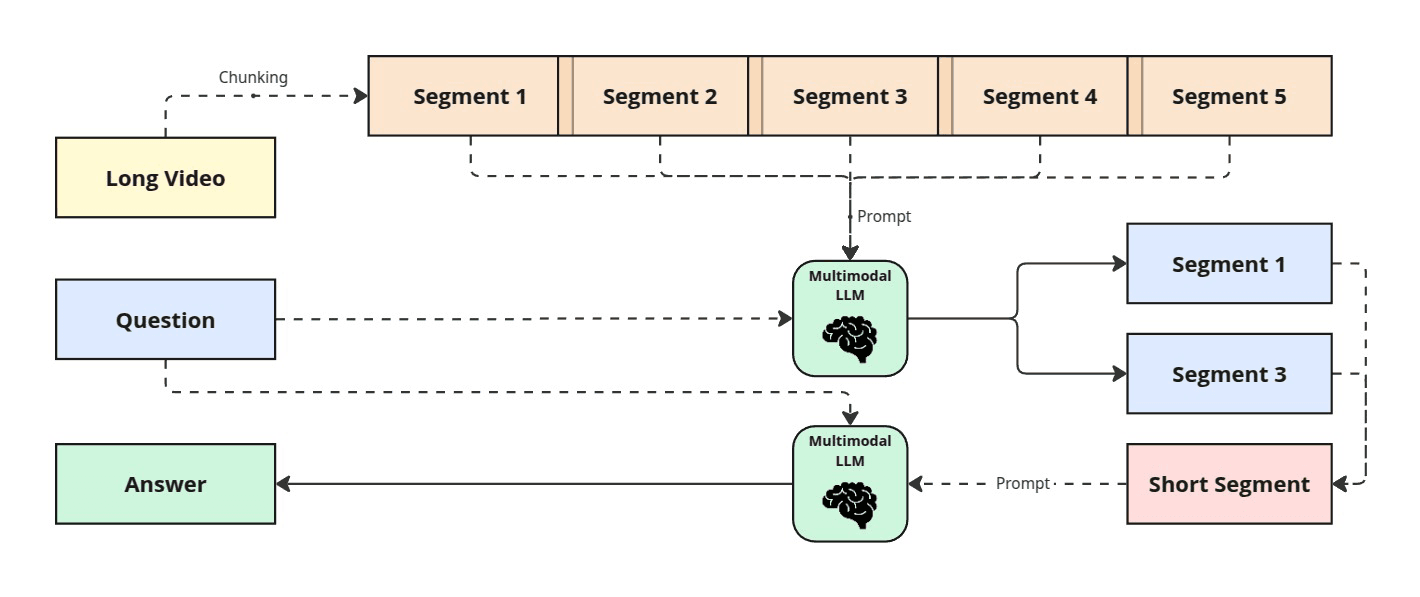
The re-ranking module merges each candidate shot with its temporal neighbours and prompts a multimodal LLM to assess relevance, sharpening the ranking. The VQA module then chunks the selected long video, uses the MLLM to keep only the segments relevant to the question, and reasons over that focused short segment — so the model spends its context budget only on content that matters.
Evaluated on a benchmark of KIS and VQA tasks derived from the Video Browser Showdown (VBS) 2019–2025, VRAG improves both retrieval precision and answer quality over a no-re-rank baseline and naive VQA prompting, across several multimodal LLMs. The work was presented in the CVPR 2025 Workshops (CVPRW).